UBTECH Robotics
See, hear and sense distance
The robot sees depth, hears, estimates distance and merges those signals into one view of the scene.
Model not named
UBTECH
UBTECH Walker S's vendor has not publicly named the models behind it, so this page sets out what is disclosed: the sensing, control and hardware, with the evidence for each part.
Walker S is an industrial humanoid built for factory work.
What UBTECH Walker S uses to sense, think, move and learn
Senses
Turns cameras, audio and touch into one picture
Understands
Works out what the job is
Predicts
Not disclosed
Acts
Chooses the movement and the grasp
Controls
Keeps the body balanced while it works
Learns
Improves the models between runs
What it learns feeds back into the models before the next run.
Greyed cards are parts the vendor hasn't named a model for.
01
It understands spoken instructions with an LLM, builds a 3D map of the factory floor to walk around safely, and uses depth cameras plus force-feedback joints to find and grasp objects. UBTECH's newer Walker S1 and S2 pages describe extra planning and learning technology, but that is family-level evidence, not confirmed proof about the exact Walker S.
UBTECH describes Walker S as deeply integrated with an LLM for intent understanding and fine-grained planning, using RGB-D/visual/audio/distance sensor fusion, 3D semantic navigation, hand-eye coordination with 6D pose recognition, and 41 force-feedback servo joints, all connectable to a factory manufacturing management system. Walker S1 adds language around general-task planning models and semantic VSLAM; Walker S2 adds a dual-loop BrainNet 2.0 + Co-Agents system and fast battery swapping.
3 confirmed as running on the robot
0 supplied by a partner
13 open questions left unanswered
Treat Walker S, S1 and S2 carefully. Walker S is the ranked item; S1/S2 add family-level evidence about task-planning, semantic VSLAM, battery swapping and Co-Agent/BrainNet, not automatically Walker S proof.
02
Single integrated stack
The vendor describes one stack rather than separate reasoning and control models.
UBTECH Robotics
See, hear and sense distance
The robot sees depth, hears, estimates distance and merges those signals into one view of the scene.
Model not named
UBTECH Robotics
Onboard brain hardware
We do not know the exact onboard brain hardware.
Not disclosed
UBTECH Robotics
Avoid people and obstacles
It tries not to hit people or objects and uses force feedback to avoid rough motion.
Model not named
UBTECH Robotics
Understand instructions
Walker S can understand a human instruction well enough to turn it into work steps.
Model not named
UBTECH Robotics
Plug into the factory system
It can plug into the factory system so it knows what job is next.
Model not named
UBTECH Robotics
No named 'imagine the future' model
There is no public sign of a separate model that imagines future outcomes before acting on this robot.
Not disclosed
UBTECH Robotics
Decide the work steps
This is the supervisor that decides what the robot should do next, described more fully on the newer Walker S1 page.
UBTECH Robotics
Map the floor and walk around obstacles
It builds a map, labels important things and walks around obstacles.
Model not named
UBTECH Robotics
See an object and decide how to grasp it
The robot has learned/control skills for seeing an object and moving its hand to grasp it.
Model not named
UBTECH Robotics
Feel force and grasp objects
The robot can feel some force in its joints and align its hand to pick things up.
Model not named
UBTECH Robotics
Stay balanced while walking and carrying
This is how it keeps itself upright while walking and carrying a load.
Model not named
UBTECH Robotics
Physical joints and servos
The hardware muscles include servos that can sense or respond to force.
Model not named
Around the stack
Named on the public record, but not part of the runtime chain above.
UBTECH Robotics
Factory use may improve future versions
Factory use generates situations the company can use to improve future versions.
03
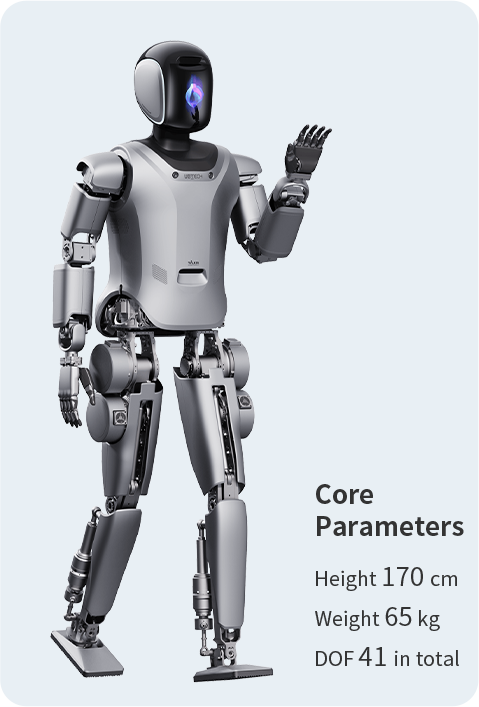
Parts sit on the body only where the public record places them. 1 of 8 entries are still not publicly disclosed.
High-resolution RGB-D sensors plus visual, audio and distance sensors.
It sees depth, hears and estimates distance.
Confirmed on this robot · Head · 1 source
Still open: Exact camera count/sensor models not public.
Built-in RGB-D sensors used for 3D semantic maps and route planning.
It uses depth vision to build a labelled map.
Confirmed on this robot · 1 source
Still open: Performance in variable lighting unknown.
Walker S page states a height of 1.7 m.
Roughly human-sized, so it can work around factory lines built for people.
Confirmed on this robot · Across the robot · 1 source
Still open: Weight and speed figures vary in secondary catalogs; keep official/secondary separate.
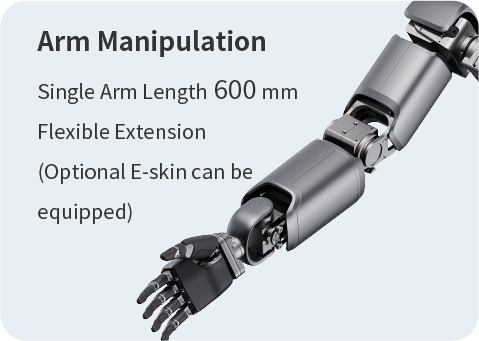
Hand-eye coordination and 6D pose recognition for grasping complex objects.
It can locate an object in 3D and line up its hand to grab it.
Confirmed on this robot · Hands · 1 source
Still open: Finger/hand tactile detail not fully disclosed.
41 servo joints with force feedback.
Many controllable joints with feedback to judge force/position.
Confirmed on this robot · Across the robot · 1 source
Still open: Exact distribution across hands/arms/legs not shown on text page.
Force-compliant drive joints and rigid-flexible coupling hybrid structures.
The joints are designed to move with some compliance rather than being brutally rigid.
Confirmed on this robot · Across the robot · 1 source
Still open: No public full actuator BOM.
No chip/TOPS disclosed on the Walker S product page.
We do not know the exact onboard brain hardware.
Not publicly disclosed · Torso · 1 source
Still open: Could be on-board/cloud hybrid; verify if published.
Walker S battery details are not prominent on the Walker S page; Walker S2 claims autonomous battery swap within 3 minutes.
For original Walker S the energy story is less clear; S2 is the battery-swap upgrade.
Confirmed for the robot family · 1 source
Still open: Do not assign Walker S2 battery swap to Walker S unless ranking explicitly tracks S2.
04
Vendor-stated scenario
This walkthrough is a reasoned synthesis of publicly disclosed architecture pieces, not a confirmed end-to-end demo transcript.
01
The robot receives a production/material-handling instruction from a human or manufacturing system.
LLM-based language interface and factory integration accept the instruction/work order.
Public pages say manufacturing-system connection; exact customer API not public.
No named model for this moment.
Confirmed on this robot · 2 sources
02
Depth and visual sensors detect the conveyor, pallet, people and obstacles.
RGB-D and multimodal sensor fusion build a 3D scene understanding.
Lighting/occlusion robustness not independently benchmarked.
No named model for this moment.
Confirmed on this robot · 1 source
03
The navigation stack makes a route from the current position to the parcel/pallet while avoiding obstacles.
3D semantic navigation plans a safe walking route.
Real-world dynamic-crowd performance not fully disclosed.
No named model for this moment.
Confirmed on this robot · 1 source
04
Object detection estimates the parcel's position and orientation for grasping.
3D point cloud processing plus 6D pose detection locate the parcel.
Depends on box variation; benchmark unknown.
No named model for this moment.
Confirmed on this robot · 1 source
05
The manipulator aligns to the object, closes its grip and adjusts using force feedback.
Hand-eye coordination and force-feedback joints perform the grasp.
Finger tactile sensing not public.
No named model for this moment.
Confirmed on this robot · 1 source
06
Balance and motion-control systems compensate for the payload and walking dynamics.
Whole-body control and low-level actuators keep the robot upright while carrying the load.
Payload/task conditions need evidence.
No named model for this moment.
Confirmed for the robot family · 2 sources
07
The robot places the item and sends updated task status to the manufacturing management system.
Motion control completes placement; factory-integration layer syncs task status.
Need public proof of repeatability and throughput.
No named model for this moment.
Confirmed on this robot · 1 source
Parts are lit where the vendor's own description puts them to work. Unlit parts still run on the robot; they are simply not what this job turns on.
05
01
The robot works
Runs the parts of the system that later receive updates (1)
02
Experience is captured
Deployment logs · Task data
03
Factory use may improve future versions
Confirmed for the robot family
04
Updates go back on the robot
Model/control improvements
Station 04 returns to station 01 — the loop repeats.
Factory use generates situations the company can use to improve future versions.
UBTECH describes S-series industrial use and a newer Walker S2 dual-loop AI system with BrainNet 2.0 plus Co-Agents.
Confirmed for the robot family
Whether the ranked Walker S receives these updates is not fully public.
What the updates land on
06
A map of the public record, not a verdict. A silent line means the vendor has not said — it never moves the ranking.
Vendor-confirmed
The vendor publicly describes this for the exact robot named on this page.
The record is silent
The public record does not say. We leave it visible as unknown.
Still open · 03
Walker S, S1 and S2 pages describe overlapping but not identical stacks.
Avoids accidentally scoring future-family capability on the older, ranked robot.
LLM and perception are described conceptually; model names and deployment details are not public.
Cloud vs onboard affects latency, privacy and reliability.
The vendor solution page lists scenarios; exact throughput, duration and customer proof require separate evidence.
Ranking should reward proof, not just vendor capability text.
07
The record
Every row is the public position. Undisclosed rows stay in the list.
08
4 primary sources sit behind this page. Where they stop, the page says so.
Vendor
The ranking measures demonstrated capability. This page explains the public system behind it. The system description does not affect the score.
Return to the UBTECH Walker S report →