See the workspace
It has sensors and software to understand workspace state.
- Artemis perception systems
Apptronik
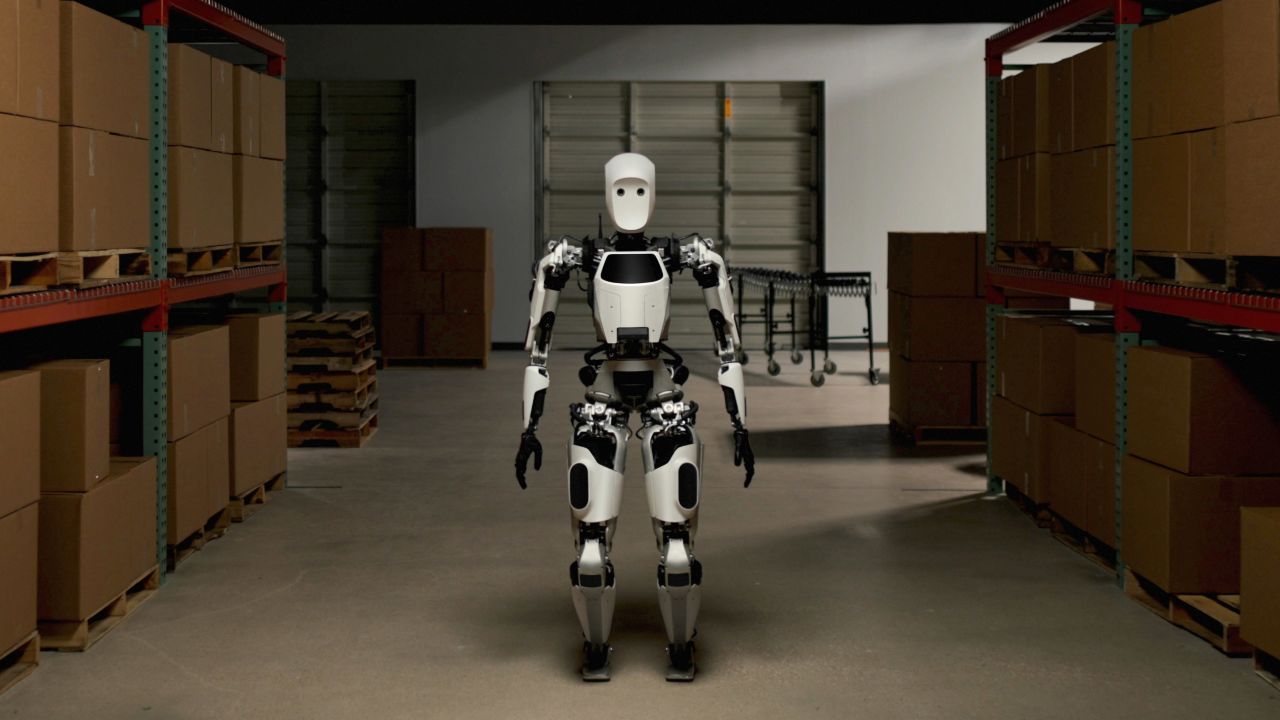
Apptronik Apollo runs Artemis HRI and Artemis on top of its own sensing and whole-body control — the parts the 6 public sources on this page actually name.
Apollo 2 is Apptronik's own humanoid body and control stack, called Artemis, which handles perception, planning, safety and human interaction.
What Apptronik Apollo uses to sense, think, move and learn
Senses
Turns cameras, audio and touch into one picture
Understands
Works out what the job is
Predicts
Not disclosed
Acts
Chooses the movement and the grasp
Controls
Keeps the body balanced while it works
Learns
Improves the models between runs
What it learns feeds back into the models before the next run.
Greyed cards are parts the vendor hasn't named a model for.
01
Apptronik also has a training-data partnership with Google DeepMind's Gemini Robotics models, but the product page centers Artemis, not Gemini, as what actually runs the robot.
Artemis coordinates perception, planning, whole-body control, safety zones and HRI across Apollo's modular legged/wheeled/stationary configurations, built on patented linear actuators and force control. Google Gemini Robotics/ER 2 is disclosed as a training and embodied-reasoning partnership; exact production-runtime usage on Apollo 2 is not publicly confirmed.
9 confirmed as running on the robot
2 supplied by a partner
13 open questions left unanswered
Apollo is a platform/body plus Apptronik's own Artemis software. Apptronik has a training-data partnership with Google DeepMind, but do not assume Gemini Robotics/ER 2 is the exact production runtime on Apollo 2 unless explicitly shown. Treat Google Gemini as partner/model context, not a confirmed first-party runtime component.
02
Three-level hierarchy
A slow reasoning layer drives a faster policy, which drives the control loop.
See the workspace
It has sensors and software to understand workspace state.
Run many robots
This is the control room for many Apollos working at a site.
Stay safe near people
It can slow/stop based on zones around it to protect people and objects.
Model not named
Predict what may happen
No named 'imagine futures' model is public for Apollo.
Not disclosed
Plan the task
Artemis is the robot's supervisor that turns goals into safe actions.
Understand people
Apollo needs to understand people and express what it is doing.
Move to the job
It can be configured to move in the way the job requires.
Choose actions
Apollo may benefit from Google's action models, but Apptronik's own product page names Artemis as the platform software that runs the robot.
Handle objects
The arms/hands are designed for practical goods movement and safe handling.
Model not named
Control the whole body
The robot's body can be controlled safely whether walking or configured with wheels.
Physical muscles
The physical muscles are designed to be efficient, safe and mass-producible.
Model not named
Around the stack
Named on the public record, but not part of the runtime chain above.
Google DeepMind
Google model partnership
Google's Gemini Robotics models are a confirmed training and technology partnership, but Apptronik's own page does not name Gemini as the thing that actually drives Apollo 2's day-to-day actions.
Apptronik / Google DeepMind
Improve over time
Apollo robots train in a dedicated facility to generate real robot data.
03
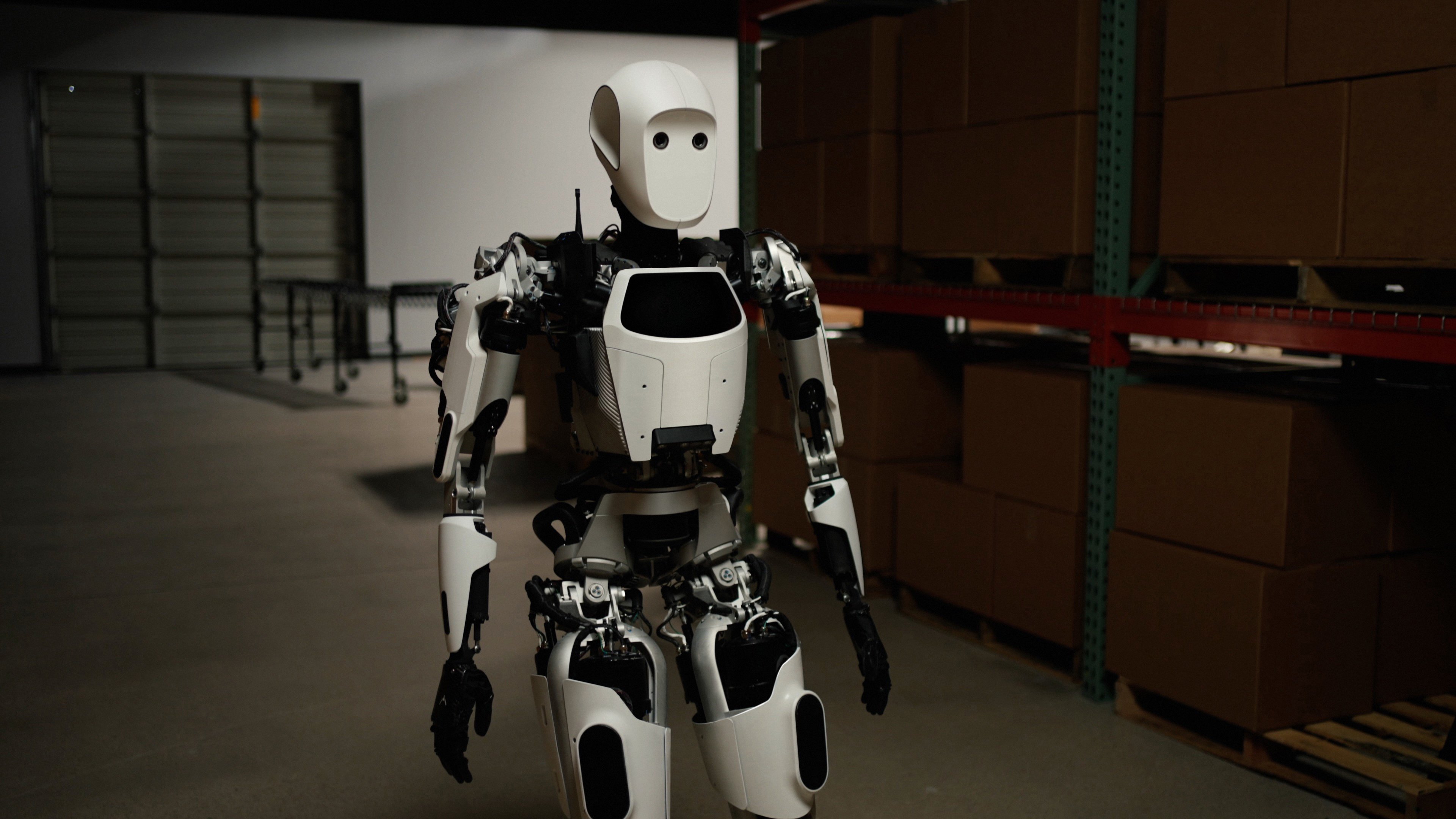
Parts sit on the body only where the public record places them. 2 of 8 entries are still not publicly disclosed.
The Apollo 2 page mentions perception systems; exact sensor list/count is not fully exposed.
Sensors exist but a full spec sheet is not public.
Not publicly disclosed · 1 source
Still open: Need an official detailed sensor table.
Original Apollo: 5'8" / 160 lb. The Apollo 2 page does not expose a full numerical table in reviewed text.
A human-size industrial robot; Apollo 2 may share similar scale but exact current numbers should be verified.
Confirmed for the robot family · 1 source
Still open: Do not assume unchanged Apollo 2 specs without a current spec table.
Modular: bipedal legs, wheeled base or stationary mount options.
Use the version that fits the job: legs, wheels or fixed station.
Confirmed on this robot · 2 sources
Original Apollo can lift 55 lb / 25 kg.
Designed for boxes/totes, not tiny-only tasks.
Confirmed for the robot family · 1 source
Still open: Apollo 2's exact payload needs a current spec.
Patented actuator technology; linear actuator approach described for the Apollo lineage.
Power-efficient robot muscles designed for scale.
Confirmed on this robot · 2 sources
Exact onboard compute is not public in reviewed sources.
We do not know the chip or its processing power.
Not publicly disclosed · 1 source
Swappable batteries; original Apollo battery had four-hour runtime. Apollo 2 enables 7-day/22-hour-style continuous operation with battery swaps and charging options.
Battery packs can be swapped so the robot can keep working shifts.
Confirmed on this robot · 2 sources
Impact zone, perimeter zone, hardware-level safety zones.
A protected bubble around the robot.
Confirmed on this robot · 1 source
04
Vendor-stated scenario
This walkthrough is a reasoned synthesis of Apptronik's public stack description, not a documented step-by-step vendor transcript of one real run.
01
The fleet system tells Apollo what to do.
Fleet Connect assigns/monitors the job; Artemis interprets it for robot execution.
Confirmed on this robot · 1 source
02
Apollo looks at the shelf and the people around it.
Perception processes shelf, tote, people and obstacles.
Sensor details are sparse.
Confirmed on this robot · 1 source
03
It chooses a route but slows/stops if someone is too close.
Artemis plans movement while impact/perimeter zones constrain behaviour near humans.
Confirmed on this robot · 1 source
04
It grabs the tote without using excessive force.
The manipulator uses force-controlled actuators to pick up the tote.
No named model for this moment.
Confirmed on this robot · 2 sources
05
It carries and puts the tote where it belongs.
Whole-body control moves the robot/body to the placement location and sets the tote down.
Cyborgs interpretation · 2 sources
06
The site can see the job is done, and real-world task data can later feed model improvements.
Task progress and robot status are logged to the fleet layer; Robot Park and partner model work can convert task data into better policies over time.
Do not assume a live ER2/Gemini runtime without further proof.
Confirmed partner integration · 3 sources
Parts are lit where the vendor's own description puts them to work. Unlit parts still run on the robot; they are simply not what this job turns on.
05
01
The robot works
Runs the parts of the system that later receive updates (2)
02
Experience is captured
Teleop/robot data · Task trials · Partner models
03
Improve over time
Confirmed partner integration
04
Updates go back on the robot
Better policies/tasks
Station 04 returns to station 01 — the loop repeats.
Apollo robots train in a dedicated facility to generate real robot data.
Apptronik's Robot Park and its Google DeepMind partnership support real-world data collection to improve AI models; this is a training/off-robot process, not a confirmed live runtime component.
Confirmed partner integration
The exact data-to-model update loop is not public.
What the updates land on
06
A map of the public record, not a verdict. A silent line means the vendor has not said — it never moves the ranking.
Vendor-confirmed
The vendor publicly describes this for the exact robot named on this page.
The record is silent
The public record does not say. We leave it visible as unknown.
Still open · 03
The partnership and training relationship is public; exact production runtime is not fully specified.
Prevents overclaiming Gemini ER 2/VLA usage as a confirmed production runtime.
Some specs come from the earlier Apollo lineage article, not confirmed for Apollo 2.
Original Apollo specs are clear; the Apollo 2 page is more qualitative, and this record must not blur the two.
Apptronik has partnerships and a training facility (Robot Park); detailed throughput/customer data should be separately collected.
Deployment evidence should be rewarded separately from architecture claims.
07
The record
Every row is the public position. Undisclosed rows stay in the list.
08
6 primary sources sit behind this page. Where they stop, the page says so.
Vendor
Partner
The ranking measures demonstrated capability. This page explains the public system behind it. The system description does not affect the score.
Return to the Apptronik Apollo report →