See the workspace
Atlas sees its work environment, but the exact eyes and sensors are not spelled out in the reviewed pages.
Not disclosed
Boston Dynamics
Atlas (electric)'s vendor has not publicly named the models behind it, so this page sets out what is disclosed: the sensing, control and hardware, with the evidence for each part.
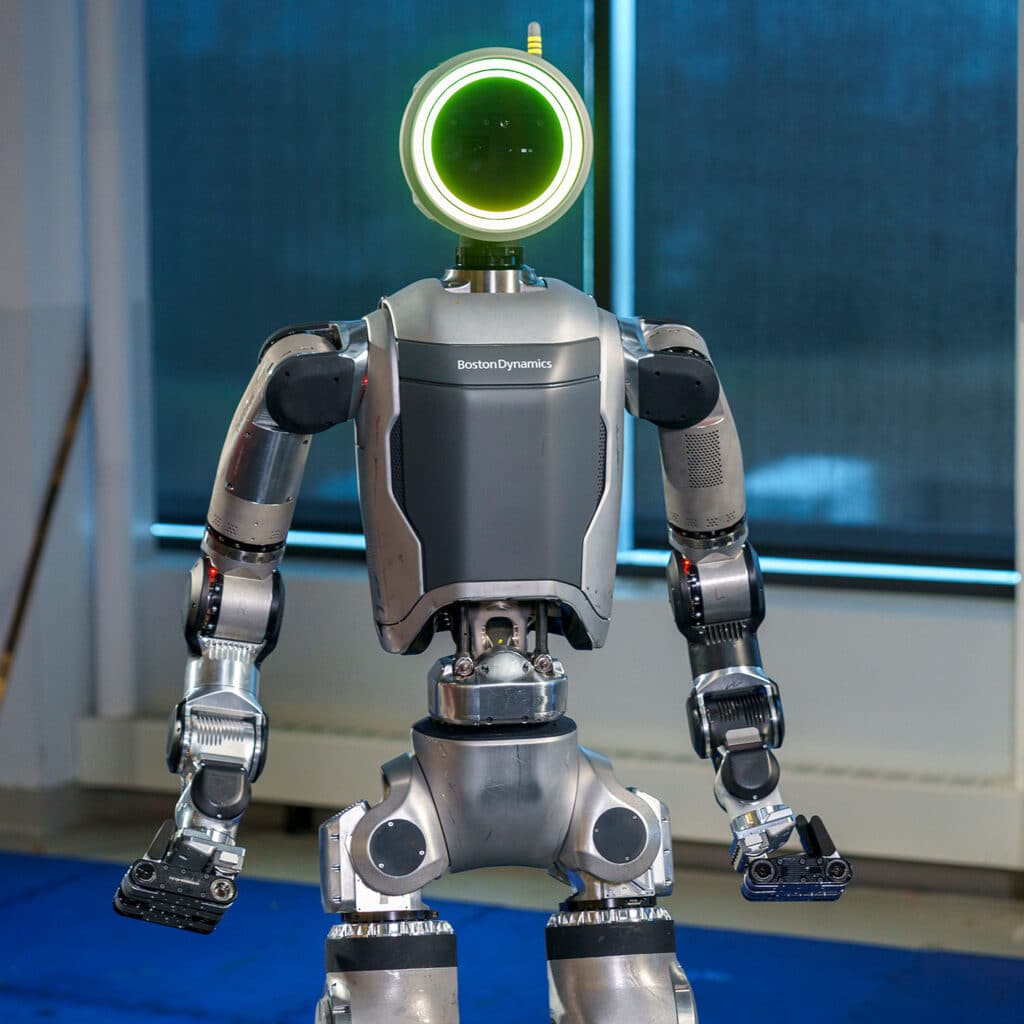
Atlas is Boston Dynamics' fully electric, highly dynamic industrial humanoid, built for factory material handling.
What Atlas (electric) uses to sense, think, move and learn
Senses
Turns cameras, audio and touch into one picture
Understands
Works out what the job is
Predicts
Not disclosed
Acts
Chooses the movement and the grasp
Controls
Keeps the body balanced while it works
Learns
Not disclosed
What it learns feeds back into the models before the next run.
Greyed cards are parts the vendor hasn't named a model for.
01
It can be run autonomously, teleoperated, or steered from a tablet. Boston Dynamics has not publicly named a language model, task planner, action model or world model behind it — the public record centers on the body's dynamics and control.
The public stack is Boston Dynamics' own autonomy/control software plus machine-learning-based perception and a fully electric, highly dynamic body (56 DoF, continuous rotational joints). No public VLA, embodied reasoner or world model comparable to Gemini Robotics, Helix or 1X's world model is named for Atlas.
5 confirmed as running on the robot
0 supplied by a partner
12 open questions left unanswered
Atlas is strongest at dynamics/control and industrial manipulation. Public sources describe modes and specs; the model stack is far less branded than at Figure, 1X or Apptronik. Do not mistake lack of model marketing for lack of technical strength, and do not assume a named VLA or world model exists just because other humanoids have one.
02
Stack not publicly named
The vendor describes what each part does, but has not named the models that run it.
See the workspace
Atlas sees its work environment, but the exact eyes and sensors are not spelled out in the reviewed pages.
Not disclosed
Run in the factory
This is a factory robot, not a home helper.
Model not named
Give it instructions
Operators can give Atlas commands or modes, but a public chat-style brain is not disclosed.
Model not named
Work in tough conditions
It is built for tougher factory conditions than home robots.
Model not named
Predict what may happen
No public future-simulation model is named for Atlas.
Not disclosed
Plan the task
There is an autonomy brain that sequences the work, but Boston Dynamics has not published it the way Google or Figure have.
Not disclosed
Move through the factory
It can be directed through a factory by an operator, and can also run autonomously in tasks.
Model not named
Choose actions
It has learned or control-based skills for moving parts, but the model name behind those skills is not public.
Model not named
Handle heavy parts
It is built to move heavy things in factories.
Model not named
Control the whole body
This is an elite movement and control platform.
Model not named
Physical muscles
Its joints can rotate in ways human joints cannot, giving unusual movement options.
Model not named
Around the stack
Named on the public record, but not part of the runtime chain above.
Improve over time
They likely train and tune heavily, but don't publish the full recipe.
Not disclosed
03
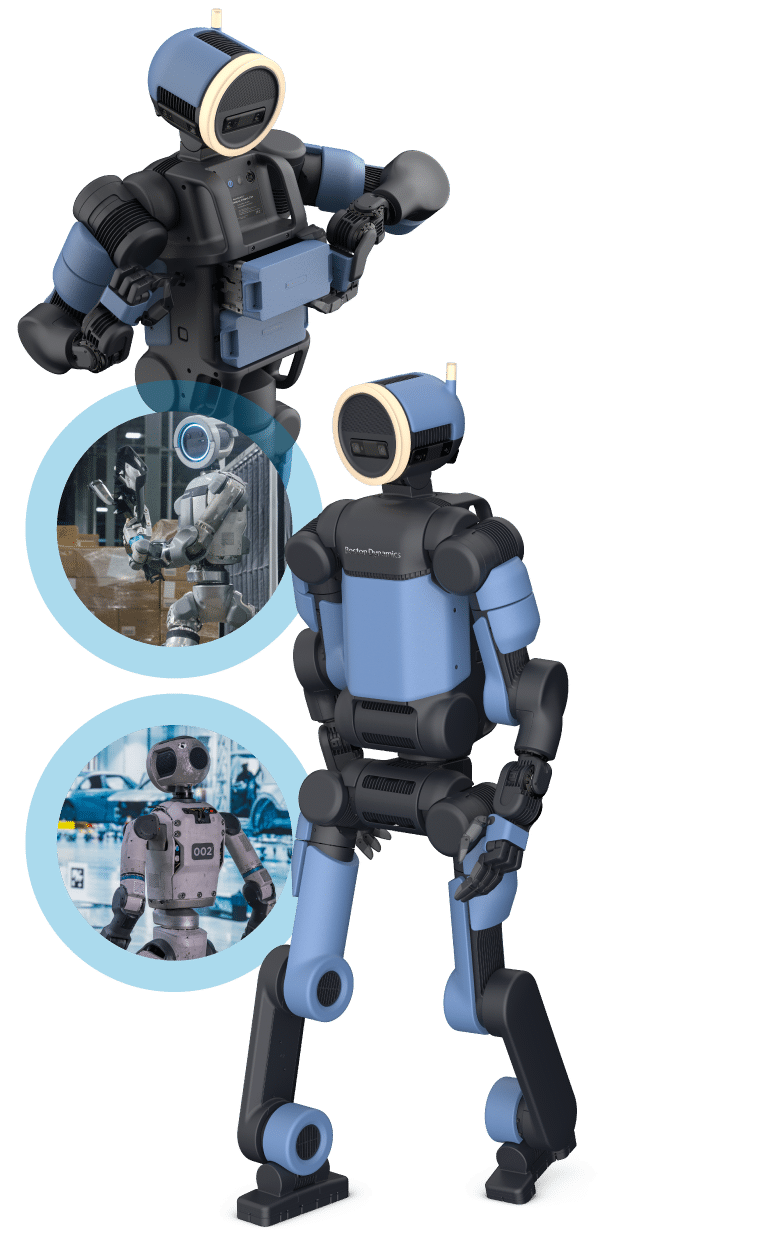
Parts sit on the body only where the public record places them. 2 of 8 entries are still not publicly disclosed.
Detailed sensor package not fully disclosed in reviewed official pages.
We know it perceives, but the exact eyes/touch sensors are not public here.
Not publicly disclosed · 2 sources
56 degrees of freedom.
Many controllable joints; highly articulated.
Confirmed on this robot · Across the robot · 1 source
Fully rotational joints.
Can turn joints continuously in ways humans cannot.
Confirmed on this robot · Across the robot · 1 source
Reach extending to 2.3 m.
Can reach far around industrial fixtures.
Confirmed on this robot · Arms · 1 source
Lift up to 50 kg.
Heavy material-handling capability.
Confirmed on this robot · 1 source
Still open: Whether this is instant or sustained lift is not distinguished in the source.
Autonomous, teleoperated and tablet-steering control modes.
Can run itself or be driven by an operator.
Confirmed on this robot · 1 source
Battery, runtime and onboard compute are not fully disclosed in reviewed official pages.
Unknown real working runtime/compute.
Not publicly disclosed · 2 sources
Water-resistant; -20°C to 40°C operating range.
Designed for harder industrial conditions than a home robot.
Confirmed on this robot · Across the robot · 1 source
04
Vendor-stated scenario
This is a vendor-described factory scenario, not a shown end-to-end deployment. Assumptions about the exact stack pieces involved are labelled as reasoned synthesis where Boston Dynamics has not confirmed the model behind a step.
01
The robot is told which part goes where.
Atlas receives a task list or operator-directed target via the autonomous/task system or tablet steering.
The natural-language interaction layer is not publicly disclosed.
Confirmed on this robot · 1 source
02
It sees the part and where it needs to go.
Sensors identify the part and the target bin/fixture.
The exact sensor/model behind this step is not public.
Cyborgs interpretation · 2 sources
03
It walks and positions itself close enough.
Atlas moves to the object using dynamic locomotion and whole-body planning.
Confirmed on this robot · 2 sources
04
It picks up the heavy part without tipping.
The manipulator grips and lifts while body posture compensates for the load, within the stated payload capability.
Confirmed on this robot · 1 source
05
If it gets stuck or bumped, it adjusts.
Controllers respond to unexpected contact or resistance via force/control feedback.
This step needs an exact demo or source per claim.
Cyborgs interpretation · 1 source
06
It puts the part into the right bin.
The robot moves and releases the part in the correct location.
Cyborgs interpretation · 1 source
07
A human can take over or guide the robot.
An operator can teleoperate or tablet-steer the robot if autonomy needs assistance.
Autonomous proof should be kept separate from operator-aided operation.
Confirmed on this robot · 1 source
Parts are lit where the vendor's own description puts them to work. Unlit parts still run on the robot; they are simply not what this job turns on.
05
01
The robot works
Runs the parts of the system that later receive updates (2)
02
Experience is captured
Robot data · Simulation · Trials
03
Improve over time
Not publicly disclosed
04
Updates go back on the robot
Improved autonomy
Station 04 returns to station 01 — the loop repeats.
They likely train and tune heavily, but don't publish the full recipe.
Boston Dynamics has decades of control/robotics experience and autonomous demos, but public training/data flywheel details are not comparable to disclosures from 1X or Figure.
Not publicly disclosed
Model and data pipeline disclosure is needed.
What the updates land on
06
A map of the public record, not a verdict. A silent line means the vendor has not said — it never moves the ranking.
Vendor-confirmed
The vendor publicly describes this for the exact robot named on this page.
Context and interpretation
A Cyborgs reading of the public record, not a vendor statement.
The record is silent
The public record does not say. We leave it visible as unknown.
Still open · 03
No named VLA, embodied reasoner or world model appears in official product pages.
Public comparison to Helix, Gemini Robotics or other named stacks needs care when Atlas has no named VLA, reasoner or world model.
Detailed sensor and compute specs are not public in the reviewed pages.
Perception and reaction speed depend on these, and none are detailed publicly.
Product positioning is industrial; deployment performance metrics are not in the official pages.
Demos and product specs differ from sustained factory-floor proof.
07
The record
Every row is the public position. Undisclosed rows stay in the list.
08
2 primary sources sit behind this page. Where they stop, the page says so.
Vendor
The ranking measures demonstrated capability. This page explains the public system behind it. The system description does not affect the score.
Return to the Atlas (electric) report →