See, hear and feel
Tesla is building a system that combines what Optimus sees, hears and feels into one picture, but the model behind it is not publicly named.
Model not named
Tesla
Tesla Optimus's vendor has not publicly named the models behind it, so this page sets out what is disclosed: the sensing, control and hardware, with the evidence for each part.
Tesla is openly building a full stack for Optimus — senses, a task brain, a movement brain and a balance system — but it has not put public names on most of these models, unlike some competitors.
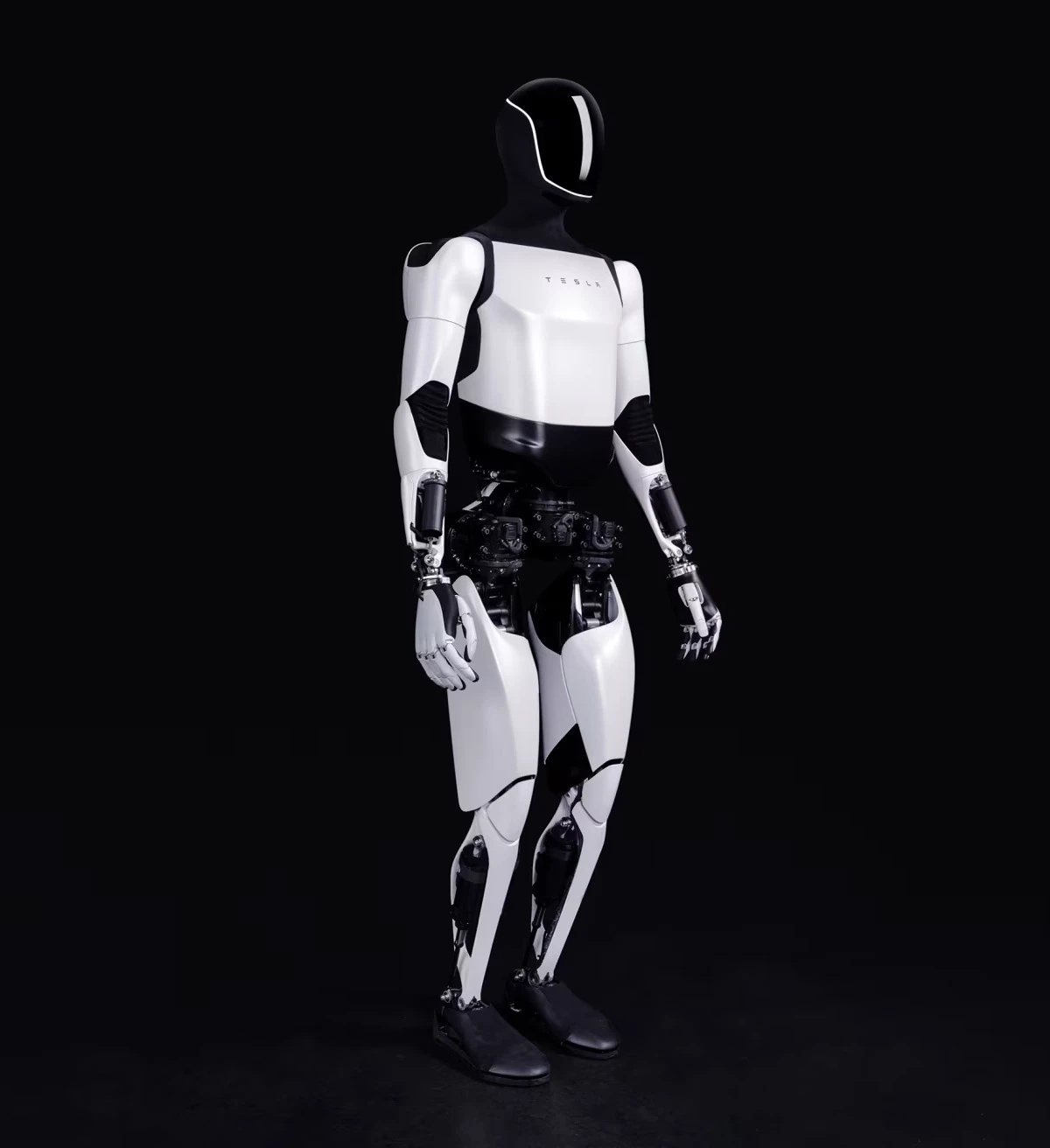
What Tesla Optimus uses to sense, think, move and learn
Senses
Turns cameras, audio and touch into one picture
Understands
Works out what the job is
Predicts
Not disclosed
Acts
Chooses the movement and the grasp
Controls
Keeps the body balanced while it works
Learns
Improves the models between runs
What it learns feeds back into the models before the next run.
Greyed cards are parts the vendor hasn't named a model for.
01
Tesla is openly building a full stack for Optimus — senses, a task brain, a movement brain and a balance system — but it has not put public names on most of these models, unlike some competitors.
Tesla's public job postings describe a vision-language-audio-tactile foundation-model layer, a robot policy for manipulation, and whole-body reinforcement-learning controls, but no named Optimus VLA, embodied reasoner or world model has been disclosed.
4 confirmed as running on the robot
The roles are visible; the models behind them are not
11 open questions left unanswered
Tesla is best treated as vertically integrated but under-disclosed. Public job postings show the layers of the stack; they do not expose model names, benchmarks or architecture diagrams comparable to Figure, Google DeepMind or 1X. This tab explains possible mechanisms and should not directly change the Cyborgs rank or score.
02
Stack not publicly named
The vendor describes what each part does, but has not named the models that run it.
See, hear and feel
Tesla is building a system that combines what Optimus sees, hears and feels into one picture, but the model behind it is not publicly named.
Model not named
Stay within limits
Tesla says Optimus is meant for unsafe, repetitive or boring tasks, but the safety architecture itself is not public in detail.
Not disclosed
Run the models
We do not know what chip or compute budget runs on board from official material.
Not disclosed
Predict what may happen
No public 'imagine possible futures' model for Optimus has been disclosed.
Not disclosed
Understand the job
There is clearly a task-understanding brain being built, but Tesla has not published its architecture or given it a name.
Model not named
Move around a space
Optimus likely reuses Tesla-style perception and planning thinking to get around, but humanoid navigation details are not public.
Model not named
Choose movement
This is the part deciding how the robot should move to do a job, but Tesla has not given it a public name.
Model not named
Use hands and re-grasp
Tesla is explicitly building grasping, re-grasping and pick-and-place skills, not just walking, but the manipulation model has no public name.
Model not named
Balance and control the body
This is the balance and body-control system that keeps Optimus upright and coordinated while it works, but it has no public product name.
Model not named
Physical body
Tesla designs its own robot hardware and 'muscles', but not every current spec is public.
Model not named
Around the stack
Named on the public record, but not part of the runtime chain above.
Improve the models
Tesla is building a training loop for robot skills, likely using both simulation and real data, off the robot rather than while it works.
Model not named
03
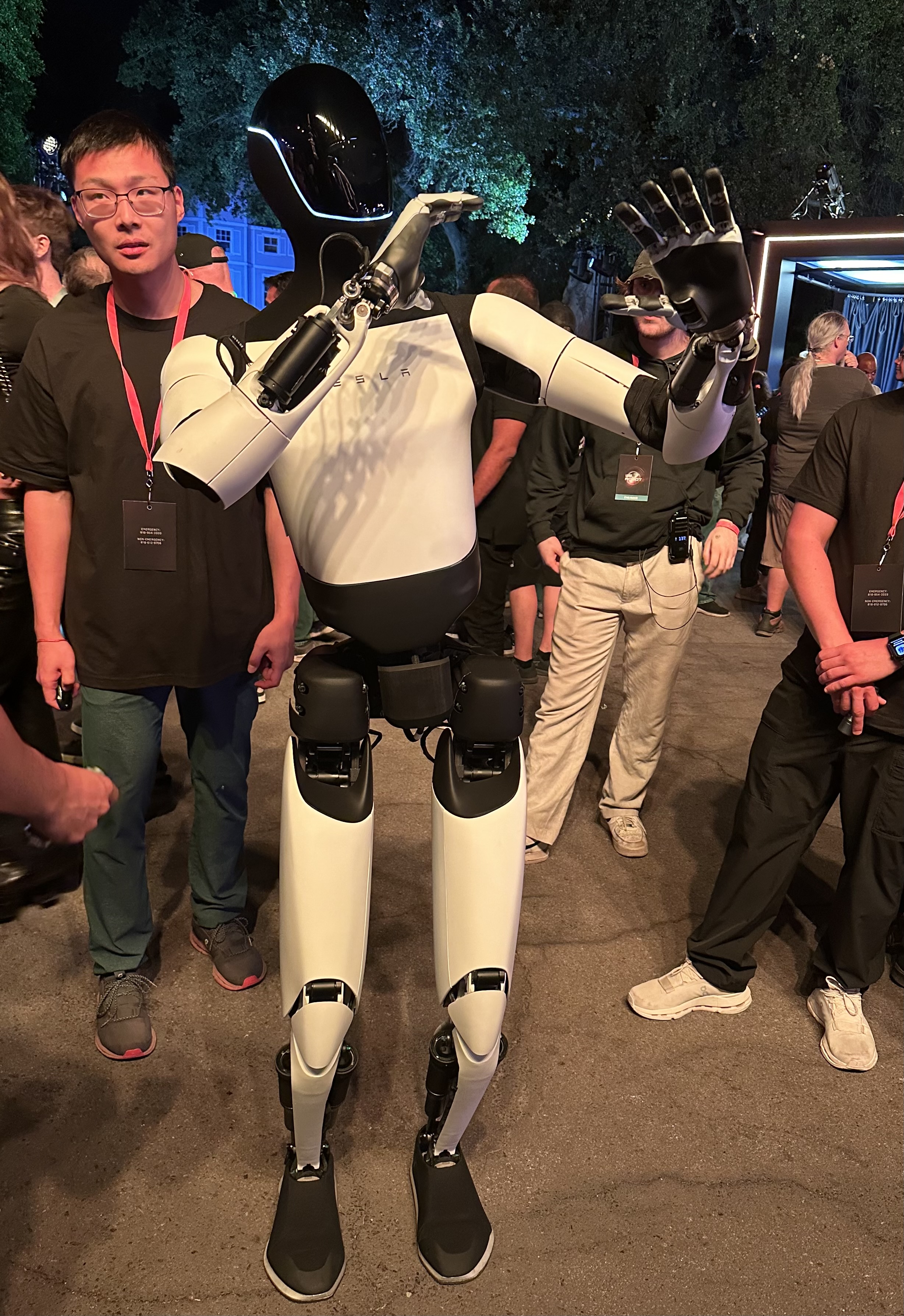
Parts sit on the body only where the public record places them. 4 of 7 entries are still not publicly disclosed.
A Tesla foundation-model role explicitly includes vision, language, audio and tactile data fusion.
Optimus's sensor roadmap includes at least vision, audio and touch streams.
Vendor-stated, pre-production · 1 source
Still open: Exact camera and microphone hardware is not fully public.
Tactile data is named as an input to the foundation-model and manipulation layers.
Touch feeds into how Optimus grips things, but the sensor itself isn't detailed.
Vendor-stated, pre-production · Hands · 2 sources
Still open: Exact tactile hardware is not public.
A manipulation engineering role covers re-grasping, pick-and-place and dexterous behaviours.
Hands and arms are clearly a major engineering focus.
Vendor-stated, pre-production · Hands · 1 source
Still open: Current hand degrees-of-freedom and specs are not stated.
Tesla-designed actuators and hardware are known at the programme level; an exact current actuator table is not in reviewed official pages.
Tesla builds its own robot 'muscles' but hasn't published the current parts list.
Not publicly disclosed · Across the robot · 1 source
Still open: Current-generation actuator counts and torques are not publicly complete.
Exact Optimus onboard compute or chip is not disclosed in reviewed official pages.
We do not know the production compute stack.
Not publicly disclosed · 1 source
Battery and runtime figures are not public in reviewed official sources.
We do not know realistic operating time between charges.
Not publicly disclosed · 1 source
Safety hardware and certification detail are not public.
We cannot yet assess the hardware safety architecture.
Not publicly disclosed · 1 source
04
Illustrative walkthrough
This is a reasoned illustration built from public job-posting descriptions of Tesla's stack, not a documented end-to-end demo of this exact task.
01
Optimus is told which parts need sorting.
Optimus receives a work instruction; the exact language or task-planning layer behind this is not public.
No public embodied-reasoner model has been disclosed for this step.
Cyborgs interpretation · 1 source
02
It looks at the bin and works out what goes where.
The vision/foundation-model layer identifies parts, tray positions and workspace layout.
Vendor-stated, pre-production · 1 source
03
It decides how to grab each part.
The robot policy chooses a grasp approach; the manipulation stack handles pick-and-place and re-grasping.
Vendor-stated, pre-production · 1 source
04
It stays balanced while reaching and moving.
The whole-body reinforcement-learning controller maintains balance and posture while the arms reach.
Vendor-stated, pre-production · 1 source
05
It may feel whether it has actually gripped the part.
Tactile data may help verify contact and grip quality; exact hand-sensor details are not public.
Exact tactile hardware is not public.
Vendor-stated, pre-production · 2 sources
06
It places the part, retries on a missed grasp, and the skill improves over time from training.
If a grasp fails, the manipulation policy can attempt a re-grasp if that behaviour has been learned; a separate training loop updates policies from real and simulated experience over time.
This describes an intended capability, not observed production performance.
Vendor-stated, pre-production · 2 sources
Parts are lit where the vendor's own description puts them to work. Unlit parts still run on the robot; they are simply not what this job turns on.
05
01
The robot works
Runs the parts of the system that later receive updates (3)
02
Experience is captured
Simulation · Robot / fleet data
03
Improve the models
Vendor-stated, pre-production
04
Updates go back on the robot
Updated policies
Station 04 returns to station 01 — the loop repeats.
Tesla is building a training loop for robot skills, likely using both simulation and real data, off the robot rather than while it works.
Job postings point to training infrastructure and reinforcement-learning policies for grasping, locomotion and control, feeding back into the manipulation and whole-body-control layers.
Vendor-stated, pre-production
Dataset scale and the policy-update cadence are not public.
What the updates land on
06
A map of the public record, not a verdict. A silent line means the vendor has not said — it never moves the ranking.
Stated, not shown
The vendor has stated the intent; it has not been shown in a shipped configuration.
Context and interpretation
A Cyborgs reading of the public record, not a vendor statement.
The record is silent
The public record does not say. We leave it visible as unknown.
Still open · 03
Tesla's job postings show the layers of a stack, but no public model name or model card exists for Optimus.
Users will compare Optimus to named stacks such as Helix, Gemini Robotics or Redwood.
No public Optimus world model has been found in reviewed official material.
Avoids false equivalence with LeCun-style, NVIDIA Cosmos or 1X World Model approaches.
The official current spec table is not present in reviewed sources; older generation figures should not be assumed current.
Readers will look for dimensions, battery, compute and payload figures.
07
The record
Every row is the public position. Undisclosed rows stay in the list.
08
4 primary sources sit behind this page. Where they stop, the page says so.
Vendor
The ranking measures demonstrated capability. This page explains the public system behind it. The system description does not affect the score.
Return to the Tesla Optimus report →