See and sense
4NE1 can see and also measure/feel how its own body is interacting with the world.
Model not named
NEURA Robotics
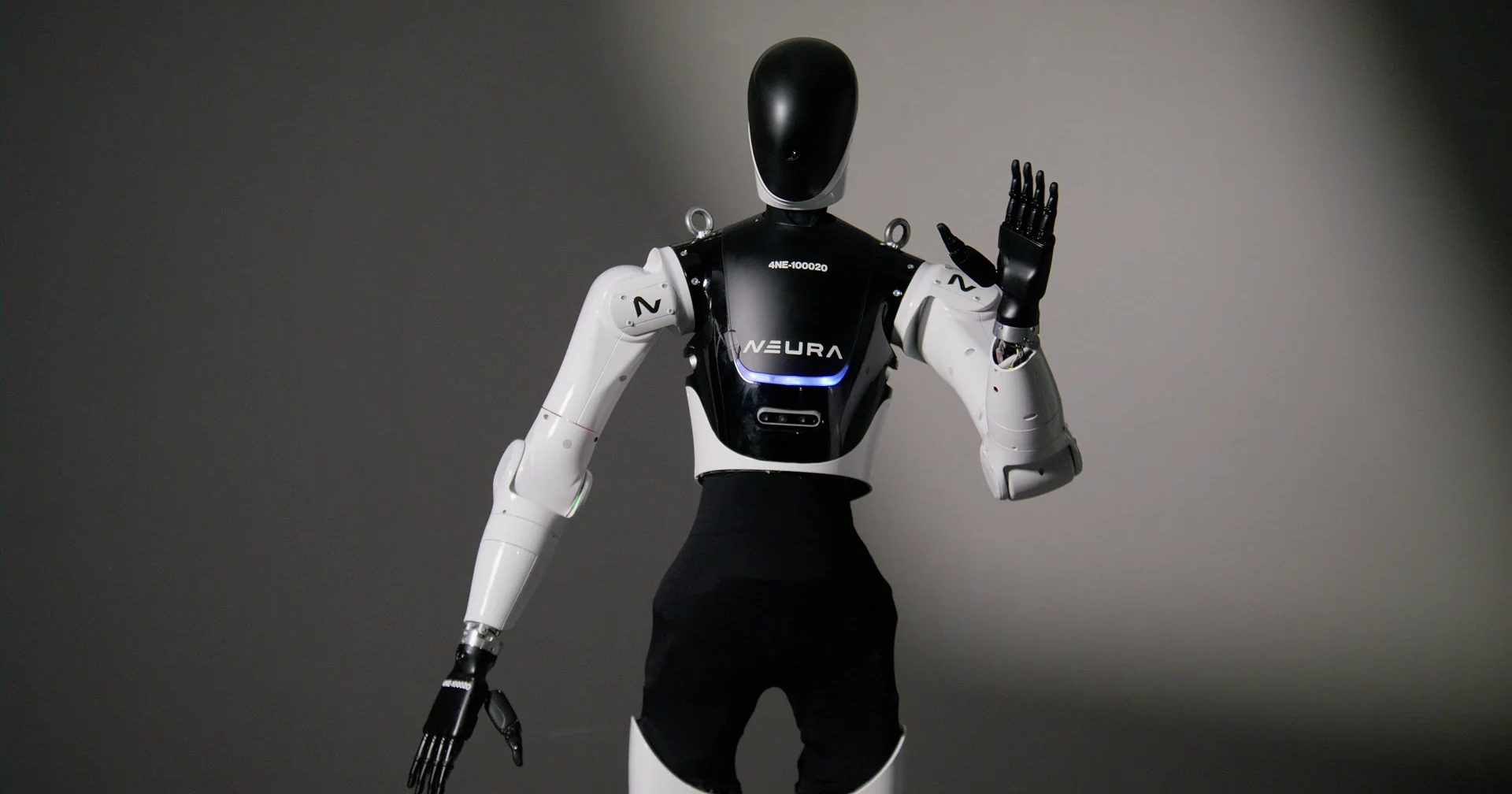
NEURA 4NE-1 runs NEURA cognitive technology on top of its own sensing and whole-body control — the parts the 3 public sources on this page actually name.
4NE1 is pitched by NEURA as a 'cognitive' humanoid that can understand language, see its environment and learn actions through reinforcement learning, moving through unstructured factory or service spaces with exchangeable arms.
What NEURA 4NE-1 uses to sense, think, move and learn
Senses
Turns cameras, audio and touch into one picture
Understands
Works out what the job is
Predicts
Not disclosed
Acts
Chooses the movement and the grasp
Controls
Keeps the body balanced while it works
Learns
Improves the models between runs
What it learns feeds back into the models before the next run.
Greyed cards are parts the vendor hasn't named a model for.
01
NEURA has not named the exact vision-language-action model or world model behind this behaviour.
The official product page describes a language model, computer vision, full-body sensing and reinforcement learning as the core cognitive stack, alongside navigation in unstructured industrial environments, exchangeable forearms and remote operation. No standalone named VLA or world-model architecture was identified in reviewed official material.
3 confirmed as running on the robot
0 supplied by a partner
15 open questions left unanswered
NEURA uses strong 'cognitive robot' positioning for 4NE1. Keep official facts separate from secondary spec catalogs, and do not assume NVIDIA GR00T or any other named model unless tied to an official/current product source. Payload figures conflict across sources (10-100 kg vendor range vs 15 kg in some secondary catalogs) and should not be read as one fixed number.
02
Stack not publicly named
The vendor describes what each part does, but has not named the models that run it.
See and sense
4NE1 can see and also measure/feel how its own body is interacting with the world.
Model not named
Run the models
The onboard computer that runs 4NE1's models is not specified publicly.
Not disclosed
Understand instructions
4NE1 can understand and use language for instructions or interaction.
Model not named
Stay safe near people
It tries to sense when people are nearby without needing a safety cage.
Model not named
Predict what may happen
No public 'imagine possible futures' model is named for 4NE1.
Not disclosed
Plan the task
NEURA says 4NE1 is meant to understand a messy workplace, work out complex tasks and adjust when conditions change.
Model not named
Decide movement
4NE1 learns actions through reinforcement learning, but the exact robot-action model is not named publicly.
Model not named
Move around the workspace
It is meant to move around real factories and service spaces, not only fixed lab layouts.
Model not named
Handle and lift objects
The arms can be swapped for different jobs and some materials advertise high lifting capacity, but the exact payload figure varies by source and configuration.
Model not named
Move and balance the body
It uses learned and control systems together to walk and adjust its body as conditions change.
Model not named
Human can step in remotely
A human operator can take over or assist remotely, and the arms can be swapped for the job at hand.
Model not named
Physical joints
The body is built for physical work near people, with strong joints for lifting.
Model not named
Around the stack
Named on the public record, but not part of the runtime chain above.
Improve over time
It has learning-based components, but how data flows back into training is sparse.
Model not named
03
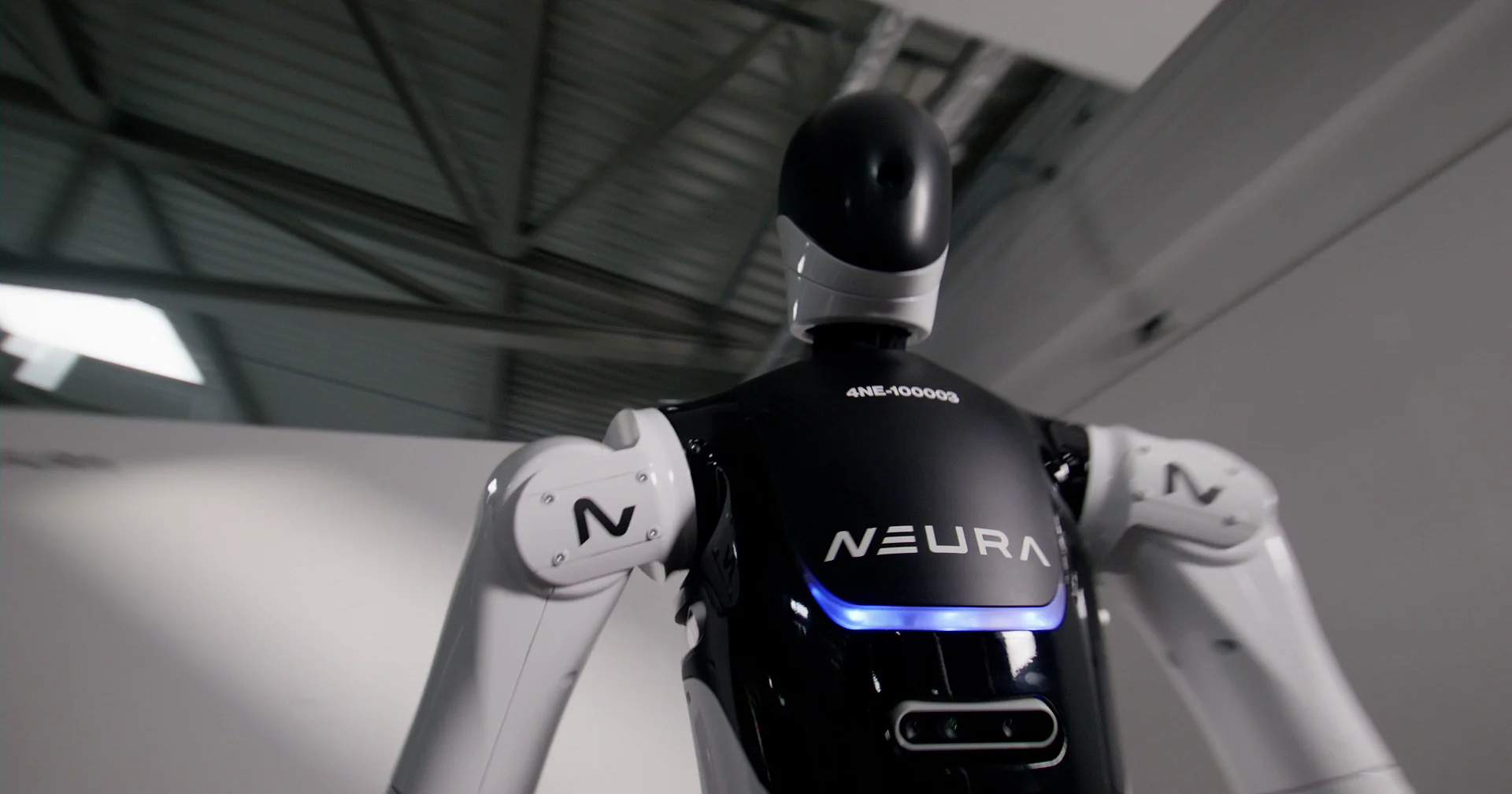
Parts sit on the body only where the public record places them. 1 of 8 entries are still not publicly disclosed.
Full-body sensing and adaptive sensors on the official page; secondary sources mention 3D vision and force-torque sensors.
It has body and vision sensors intended for safe, aware work.
Confirmed on this robot · 2 sources
180 cm height and 80 kg weight listed on the official 4NE1 page.
A tall, heavy, human-scale industrial robot.
Confirmed on this robot · Across the robot · 1 source
5 km/h walking speed listed on the official page.
Its walking speed for moving through a workspace.
Confirmed on this robot · Across the robot · 1 source
Still open: Task-specific speed may be lower than this stated figure.
Exchangeable forearms, per the official product page.
The end effectors/forearms can be swapped out for different jobs.
Confirmed on this robot · Arms · 1 source
Official product page states a payload range of 10-100 kg; secondary sources often list around 15 kg for specific versions.
Payload varies by configuration — do not treat the maximum as true for every task.
Conflicting public disclosures · 3 sources
Still open: Which payload applies to a specific ranked variant needs version-specific proof.
No named chip or TOPS figure on the official product page.
The onboard computer is not specified.
Not publicly disclosed · 1 source
NEURA's launch article describes an intelligent dual-battery system for 24/7 operation, from a Gen 3.5 family/platform announcement rather than a 4NE1-specific spec sheet.
Designed to keep working continuously via battery management/swaps, though the exact 4NE1 configuration is unconfirmed.
Confirmed for the robot family · 1 source
Still open: Confirm the exact Gen 3.5 / 4NE1 battery configuration.
Full-body sensing and safe human interaction on the official page; secondary catalogs add touchless human-detection sensors.
It can sense people and contacts to try to work safely near humans.
Confirmed on this robot · 2 sources
Still open: Independent safety certification is not in the reviewed text.
04
Vendor-stated scenario
This walkthrough follows NEURA's own workbook scenario for 4NE1, combining vendor-confirmed capability claims with reasoned links between them. It is not a documented, repeatable public demonstration video; several steps (planning the lift, placing on the shelf) are reasoned synthesis rather than confirmed runtime behaviour, because NEURA has not published a detailed task-level architecture for this exact sequence.
01
A worker gives a spoken or text command describing the pick-and-place job.
The user gives a spoken or text command; the language layer parses intent.
Confirmed on this robot · 1 source
02
It looks at the workspace and finds the box, the shelf and relevant constraints.
Vision detects the object, shelf and workspace constraints.
Confirmed on this robot · 1 source
03
Before making a large movement, it checks whether a person is too close.
The safety system monitors nearby humans before large movement.
Sensor details for human detection are partly secondary-sourced.
Confirmed on this robot · 2 sources
04
It works out how to approach and lift the box without tipping, given its payload and posture.
The system decides how to approach and lift, considering payload and body posture; no explicit public planner architecture is described.
No explicit public planner architecture supports this step in detail.
Cyborgs interpretation · 1 source
05
As the box loads onto the robot, it feels the weight and adjusts its body and arm forces.
A control loop adjusts body and arm forces as the object loads the robot, using force/torque and adaptive control.
Confirmed on this robot · 2 sources
06
It moves arms, torso and legs together to place the box without losing balance.
The robot coordinates arms, torso and legs together to place the object.
Cyborgs interpretation · 1 source
07
If the robot cannot finish the step autonomously, a remote operator can take over or assist.
A remote operator can take over or assist if the robot cannot complete the step autonomously.
Separate autonomous performance from remote-assisted performance — public material does not clearly distinguish the two.
Confirmed on this robot · 1 source
Parts are lit where the vendor's own description puts them to work. Unlit parts still run on the robot; they are simply not what this job turns on.
05
01
The robot works
Runs the parts of the system that later receive updates (1)
02
Experience is captured
Simulation data · Robot data
03
Improve over time
Confirmed on this robot
04
Updates go back on the robot
Policy improvements
Station 04 returns to station 01 — the loop repeats.
It has learning-based components, but how data flows back into training is sparse.
The official page lists reinforcement learning as part of the stack, but no public fleet-wide learning loop is described.
Confirmed on this robot
Training data, online learning and update process are not public.
What the updates land on
06
A map of the public record, not a verdict. A silent line means the vendor has not said — it never moves the ranking.
Vendor-confirmed
The vendor publicly describes this for the exact robot named on this page.
Reported or contested
Public sources disagree; we show the conflict rather than pick one.
The record is silent
The public record does not say. We leave it visible as unknown.
Still open · 04
The official page lists language, vision and reinforcement learning, but no named VLA or action foundation model is disclosed.
Public understanding needs to know whether 4NE1 runs a VLA, an RL skill stack, or a classical/planning hybrid, since these imply very different capabilities and failure modes.
Public sources vary by variant: the vendor states a wide range while some secondary catalogs list smaller figures such as 15 kg.
A 10-100 kg range is broad and could mislead buyers or readers into assuming the top figure applies to every configuration or task.
Capabilities such as navigation, planning and lifting are described, but sustained real-world deployment data needs separate, independent evidence.
A ranking must be proof-based, not based on vendor capability descriptions alone.
No chip name or TOPS figure is found in the reviewed official material.
Compute constrains what models can realistically run onboard versus in the cloud or via remote operation.
07
The record
Every row is the public position. Undisclosed rows stay in the list.
08
3 primary sources sit behind this page. Where they stop, the page says so.
Vendor
Other
The ranking measures demonstrated capability. This page explains the public system behind it. The system description does not affect the score.
Return to the NEURA 4NE-1 report →