See and sense
It likely has cameras, touch and force sensing and a sense of its own body, but the exact hardware and how it is fused is not confirmed by the vendor in detail.
Model not named
Kepler Robotics
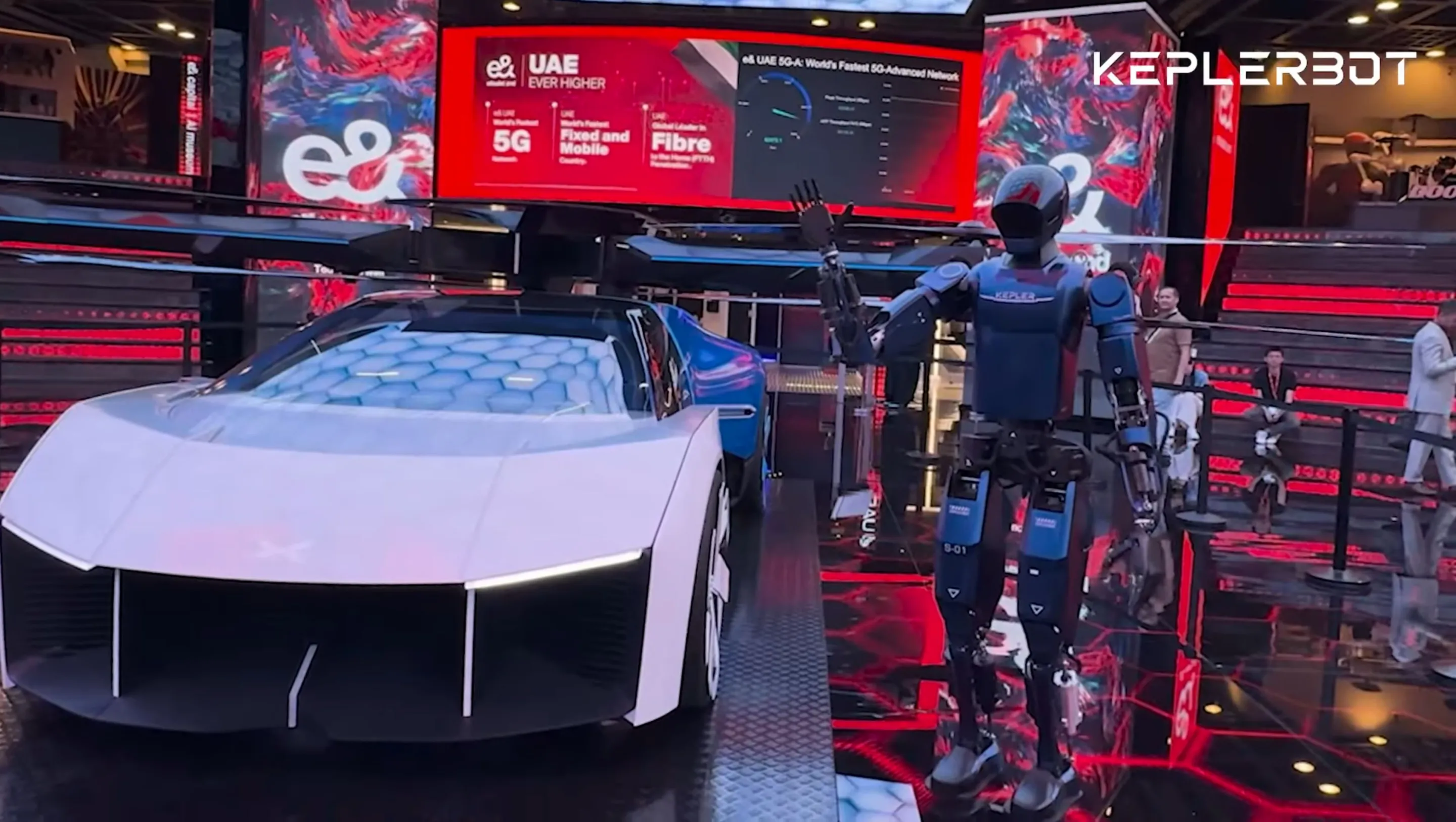
Kepler Forerunner K2's vendor has not publicly named the models behind it, so this page sets out what is disclosed: the sensing, control and hardware, with the evidence for each part.
Kepler shows a strong-looking industrial humanoid body — height, weight and actuator strength are public — but Kepler has not publicly named the software that understands instructions, plans tasks, predicts outcomes or decides what the hands should do.
What Kepler Forerunner K2 uses to sense, think, move and learn
Senses
Turns cameras, audio and touch into one picture
Understands
Works out what the job is
Predicts
Not disclosed
Acts
Chooses the movement and the grasp
Controls
Keeps the body balanced while it works
Learns
Not disclosed
What it learns feeds back into the models before the next run.
Greyed cards are parts the vendor hasn't named a model for.
01
Kepler shows a strong-looking industrial humanoid body — height, weight and actuator strength are public — but Kepler has not publicly named the software that understands instructions, plans tasks, predicts outcomes or decides what the hands should do.
Public material confirms bionic structure, motion control and peak actuator torque, plus secondary reports of vision, tactile, force-torque and IMU sensing. No vendor-named LLM, task planner, VLA/action policy or world model has been identified for K2.
0 confirmed as running on the robot
0 supplied by a partner
12 open questions left unanswered
Kepler's official page confirms selected physical specs, but the intelligence stack — language interface, task reasoner, world model, action policy, safety and learning — has no public named architecture. Many hardware details (52 DoF, hand DoF, tactile distribution) come from secondary catalogs, not the vendor, and should be read with lower confidence. This tab explains possible mechanisms; it does not change the Cyborgs rank or score.
02
Stack not publicly named
The vendor describes what each part does, but has not named the models that run it.
See and sense
It likely has cameras, touch and force sensing and a sense of its own body, but the exact hardware and how it is fused is not confirmed by the vendor in detail.
Model not named
Understand instructions
We do not know the exact system that understands a spoken or typed instruction.
Not disclosed
Stay within limits
We do not know what hard safety systems — stop behaviour, proximity limits, force limiting — K2 actually has.
Not disclosed
Run the models
The reviewed official material does not name an onboard chip or compute budget.
Not disclosed
Predict what may happen
There is no public evidence of a separate model that imagines possible futures before acting.
Not disclosed
Plan the task
There may be a planning brain that breaks a job into steps, but the public evidence for it is thin and mostly secondary.
Model not named
Decide movement
We do not know whether K2 uses a modern vision-language-action model or more traditional programmed skill controllers.
Not disclosed
Move around the workspace
It is meant to move through industrial workspaces, but the exact navigation software is not named publicly.
Model not named
Handle objects
The hand and joint hardware looks aimed at precise object handling, but that comes from catalogs rather than a vendor spec sheet.
Model not named
Control balance and body
It has the body and actuators built for humanoid walking and balance, though the detailed control software is not public.
Model not named
Physical body
The robot's joints are built for strength and precision, with a stated peak torque figure.
Model not named
Around the stack
Named on the public record, but not part of the runtime chain above.
Improve over time
We do not know how, or whether, K2 learns from data collected across a fleet of robots.
Not disclosed
03
Parts sit on the body only where the public record places them. 2 of 8 entries are still not publicly disclosed.
Secondary sources list vision, tactile, force-torque and IMU sensors.
Likely eyes, touch, force and balance sensing, but not an official sensor table.
Reported for this robot · 1 source
Still open: Vendor sensor sheet needed.
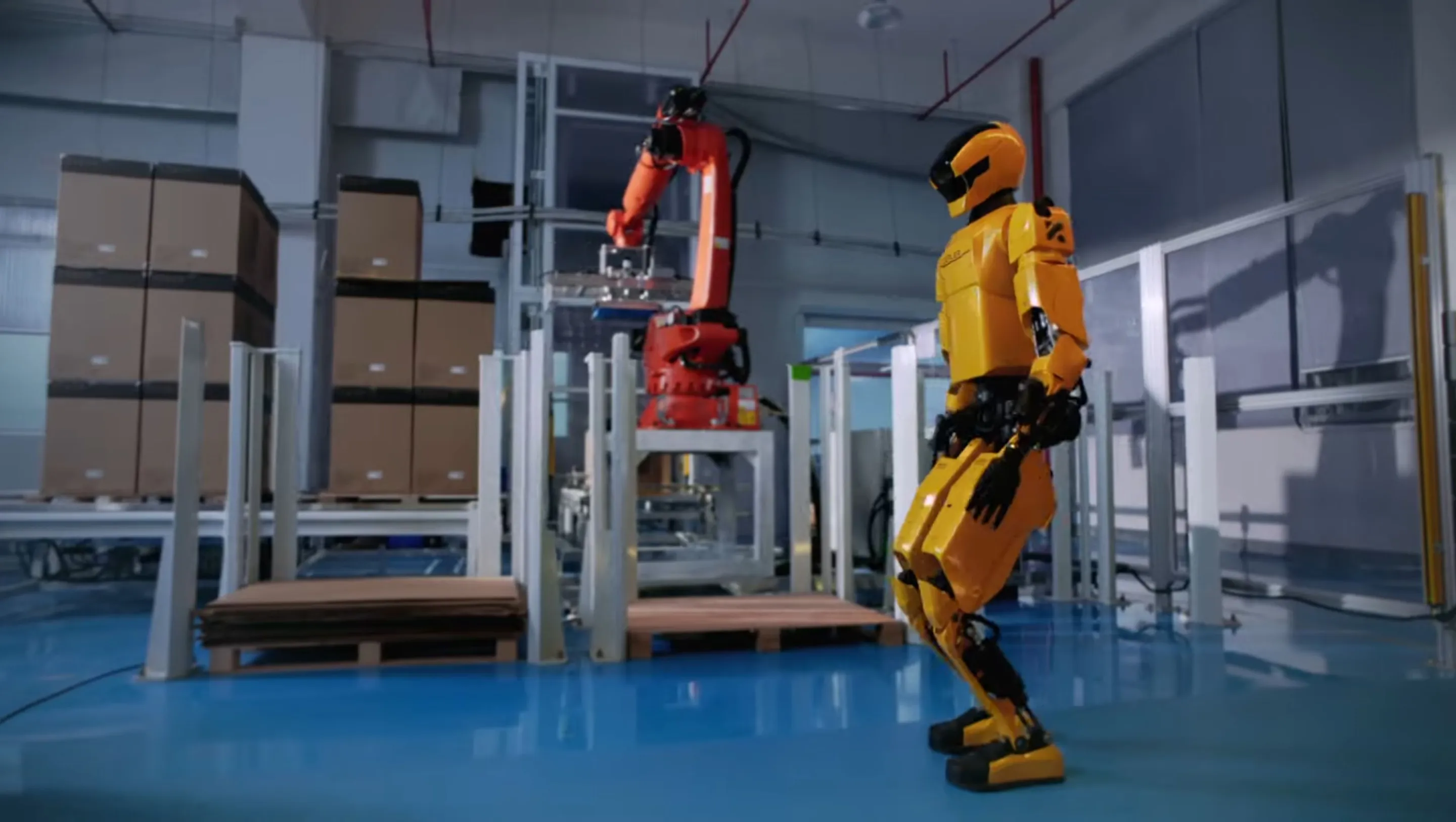
Official page indicates 178 cm height and 85 kg weight.
A human-scale but heavy industrial body.
Confirmed on this robot · Across the robot · 1 source
Secondary catalogs list 52 degrees of freedom.
Many controllable joints for whole-body movement, but not vendor-confirmed.
Reported for this robot · 1 source
Still open: Needs official confirmation.
Secondary sources describe dexterous five-digit hands with tactile sensing; some list 11 DoF per hand.
Hands built to feel contact, per catalogs rather than an official spec sheet.
Reported for this robot · Hands · 2 sources
Still open: Official hand specification is needed.
Official page gives 200 N·m peak actuator torque; secondary sources describe planetary roller screw plus rotary actuators.
Strong, precise joints designed for industrial work.
Confirmed on this robot · 2 sources
Still open: Torque per individual joint is not public.
No named chip or TOPS figure found in the reviewed official material.
We do not know the onboard computer from official material.
Not publicly disclosed · 1 source
Secondary sources mention long operating time; official battery capacity and runtime are unclear.
Do not treat unverified all-shift runtime claims as fact.
Reported for this robot · 2 sources
Still open: Official energy specification needed.
No detailed public safety hardware found beyond general industrial positioning.
The emergency-stop, force-limiting and proximity safety package is unknown.
Not publicly disclosed · 2 sources
04
Vendor-stated scenario
This walkthrough is a reasoned industrial scenario built from Kepler's public positioning and hardware claims, not a documented, repeatable public demonstration. Most steps are marked as reasoned synthesis rather than confirmed runtime behaviour, because Kepler has not published a task-level architecture or a proof video matching this exact sequence.
01
A work order or operator instruction specifies which part to pick and where it goes.
A work-order system or operator gives a pick-and-place task; public planner details are not disclosed.
The task planner itself is not public.
Cyborgs interpretation · 2 sources
02
It identifies the tote, the fixture and a safe approach path.
Vision/localization identifies the tote, fixture and safe approach path.
Cyborgs interpretation · 1 source
03
It walks to the station while keeping its balance.
The locomotion controller walks to the station while maintaining balance.
Cyborgs interpretation · 1 source
04
The hand closes around the part, using contact feedback to avoid dropping or crushing it.
Perception estimates component pose; the hand closes on the part and tactile/force feedback reduces slip or excessive force once contact occurs.
Official tactile-grasping proof is needed; this relies on secondary hand specifications.
Reported for this robot · 2 sources
05
The arm and hand follow a controlled path to insert or position the part.
The arm/hand follows a controlled placement path to insert or position the part.
Cyborgs interpretation · 1 source
06
If the part slips or alignment fails, what the robot does next is not publicly documented.
If part slips or alignment fails, public recovery behaviour is unknown.
This is called out in the workbook as a critical evidence gap, not an assumption to fill in.
Not publicly disclosed · 1 source
Parts are lit where the vendor's own description puts them to work. Unlit parts still run on the robot; they are simply not what this job turns on.
05
01
The robot works
Runs the parts of the system that later receive updates (1)
02
Experience is captured
Robot data
03
Improve over time
Not publicly disclosed
04
Updates go back on the robot
Model updates
Station 04 returns to station 01 — the loop repeats.
We do not know how, or whether, K2 learns from data collected across a fleet of robots.
No public fleet or data-learning loop was found for K2 comparable to disclosures from 1X, Figure or AgiBot.
Not publicly disclosed
Needs vendor disclosure.
What the updates land on
06
A map of the public record, not a verdict. A silent line means the vendor has not said — it never moves the ranking.
Vendor-confirmed
The vendor publicly describes this for the exact robot named on this page.
Reported or contested
A secondary source reports this for the exact robot; the vendor has not stated it directly.
Context and interpretation
A Cyborgs reading of the public record, not a vendor statement.
The record is silent
The public record does not say. We leave it visible as unknown.
Still open · 05
No named vision-language-action model, task reasoner or world model has been found for K2 in the reviewed sources.
K2's hardware looks strong, but a humanoid's usefulness depends heavily on the reasoning, action and safety software running on top of it.
Many detailed K2 specs, including 52 DoF and hand tactile distribution, come from secondary catalogs rather than the official Kepler page.
Mixing vendor-confirmed facts with unverified secondary-catalog numbers risks overstating what is actually known about K2.
Kepler describes industrial/logistics positioning, but repeatable public task evidence needs separate collection and has not been established here.
Industrial positioning is not the same as demonstrated, repeatable task performance.
No chip name or TOPS figure was found in the reviewed official material.
Compute constrains what models, if any, can realistically run onboard versus in the cloud.
No detailed public safety architecture was found beyond general industrial positioning.
Working near people or in shared industrial space requires demonstrated, not assumed, safety behaviour.
07
The record
Every row is the public position. Undisclosed rows stay in the list.
08
3 primary sources sit behind this page. Where they stop, the page says so.
Vendor
Other
The ranking measures demonstrated capability. This page explains the public system behind it. The system description does not affect the score.
Return to the Kepler Forerunner K2 report →